Wednesday, February 26, 2014

Mormon Dialectics

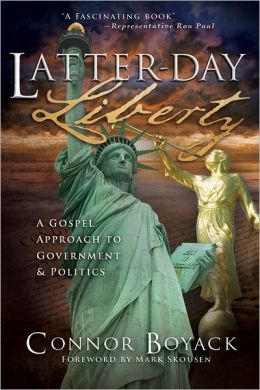
icon I was extremely disappointed with Connor Boyack's "Latter Day Liberty." I had hoped to read a book like Skousen's "5000 Year Leap" which made a compelling defense of liberty. Boyack's work was dragged down by an excessive focus on group identity and oppositional dialectics.

I would not recommend the work to anyone interested in learning about philosophy of liberty. However, the read provides a good example of how oppositional dialectics undermines freedom.

Connor Boyack's goal in writing Latter-day Liberty is not simply to argue liberty from a Mormon perspective. It is to make the claim that LDS Church is privy to the correct the definition of liberty and virtue and that fellow travelers in the age old pursuit of liberty (such as the US Founders) were deficient in their knowledge of liberty as they were not part of the political hierarchy of the LDS Church.

Latter-day Saints are blessed with an increased understanding of who we are, why we're here on earth, and what consequences our mortal actions have. This knowledge can and should inform the laws and policies we support in earthly government.

As a non-Mormon living in Utah, this claim that one's group identity gives people an increased understanding of liberty and virtue comes off like the pigs of Animal Farm claiming that the pigs are more equal.

Mr. Boyack goes on to explain that this increased understanding is "due to the revelations that we have been given regarding God's plan of salvation and the War in Heaven." (page 17).

Much of this revelation came from a collection of essays by Joseph Smith called "The Book of Moses. The essays are often bundled with "The Pearl of Great Price." This particular work was supposedly translated from Egyptian papyrus purchased from a traveling mummy show. The documents associated with this event were later determined to be common Egyptian funery.

The "Book of Moses" tells us that man had a pre-existence in the Heavenly Kingdom. In his divine plan for the earth, the Heavenly Father set up a conflict between Jesus and Satan and that this War in Heaven is reflected in the war on earth (The Culture War).

BTW, the idea that the heavens are filled with gods and that life on earth is reflexive of the war in heaven is not new. This idea is called "polytheism." It has been common throughout history.

This plan for salvation is that there would be a conflict between the righteous (the members of the LDS Church) and the Servants of Satan ... the people not in the hierarchy also known as gentiles or non-Mormons.

The plan for salvation depends heavily on the concept of "free agency." The Heavenly Father gave man free agency so that they could make the choice between joining the righteous in the political hierarchy of the LDS Church and obeying its command. Those whose hearts are hardened by Satan and who do not use agency to join the political hierarchy of the church and do as they are told are cast out. Mormon free agency is a paradox. You are given free agency to see if you willing do as you are told. Joseph repeats multiple times that those who do not are to be cast out.

Boyack quotes an Elder Bruce R. McConkie on the Mormon Doctrine of Free Agency in a work titled Mormon Doctrine published in 1979: [I added the HTML OL formatting]


Four great principles must be in force for their to be agency:
  1. Laws must exist, laws ordained by an Omnipotent power, laws which can be obeyed or disobeyed.
  2. Opposites must exist—good and evil, virtue and vice, right and wrong.
  3. A knowledge of good and evil must be had by those who enjoy the agency, that is they must know the difference between the opposites; and
  4. An unfettered power of choice must prevail.

It just so happens that I read Hegel (1770-1831) before I read Joseph Smith (1805-1844). When I read the writings of Joseph Smith, I was struck by the similarities between Mormon Dialectics and Hegelian Dialectics. This is not surprising. Hegel was the rage in the 1820s when Joseph Smith wrote the Book of Mormon.

How did German thought penetrate American conservative circles?

Hegel was a product of the German University system which was largely funded by the Hanoverian Kings of England (King George I, King George II, King George III). The Kings of England sought intellectual support for the monarchy. Hegelian dialectics was, was very much, a reactionary effort to present monarchist views as progressive. This dialectic process presented centralization and nationalization as progressive.

To a large extent, Hegel was simply rewriting the "Divine Right of Kings" in pseudo-philosophic speak. Oppositional logic reaches back into antiquity.

The three key elements of Hegelian dialectics are: The use of a conflict driven version of history, The use of oppositional logic, and a paradoxical definition of freedom (sublation).

Mormonism follows this pattern it creates a fantastic conflict driven history of the world: The Book of Mormon tells the story of the Nephites who were pitted against the Lamanites (servants of Satan). The Nephites strayed from the path of righteousness and were eventually pulled into a war of extermination. The children of the conflict were reduced to the "red-savages" now known as native Americans.

In the book The Covenant by Tim Ballard, we learn that The American Revolution was staged by the Heavenly Father and the Constitution was revealed specifically to create the conditions necessary for the restoration of the church which came to Joseph Smith a decade after Hegel. The new revelation came as "The Book of Commandments" which created the United Order of Enoch. Joseph Smith's followers rebelled on and Smith rewrote the Book of Commandments as The Doctrine and Covenant.

Joseph Smith's paradoxical definition of freedom is that people were given freedom as a test to see if they would follow whatever the LDS Church declared to be divine law. Those who do not follow the divine law are to be "cast out." Both the Book of Commandments and the Doctrine and Covenant demand multiple times that those who do not adhere to the dictates of the the Church hierarchy be cast out and denounced as evil.

Mormons actively practice the casting out of people. The lost boys who are thrown out of the FLDS community provide a sensational example of this ideology, but one finds more subtle examples of people caught in double binds in the LDS community.

Mormon dialectics allows the politically powerful to abuse people while declaring themselves the self-righteous defenders of liberty and all that is good.

The dialectics is compelling. People are drawn to it like flies. By employing conflict and paradox, dialecticians can create a sense of ideological impenetrability for a political group. On the whole, history shows that dialectics tends to divide society into warring groups that are completely incapable of communicating with others.

A prime example of the divisive effects of dialectics happens with the paradox of unity. When community organizers use dialectics to unite half a community against the other half, the organizer ends up creating deeper division despite the use of the rosy language of unity.

The Left is notorious for dialectics. The Left routinely labels people and groups "oppressors" then engage in a struggle against their targets without realizing that targeting and struggling against people is oppression.

Classical logic, on the other hand, sought to avoid paradoxes. The classical liberal approach to liberty sought to avoid the freedom paradox. The freedom paradox is easy to see in the simple question: Is a person free to take others as slaves? Classical Liberals, employing classical logic, concluded that one's freedom must stop when it imposes on the freedoms others. My personal freedom cannot include the freedom to enslave you.

The reactionaries to the American Revolution sought to preserve the social order of the monarchy and to preserve the peculiar institution of slavery. These groups flocked to Hegelian dialectics. Hegel was the rage in the early 1800s because his dialectics provided a mechanism to justify the behaviors and desires of the politicians of the day.

The dialecticians of the 1800s claimed that the classical liberals (the US founders, et al) had a naive definition of "liberty."

It was the dialecticians of the day who had the bad definition. These intellectual rogues simply built on all possible versions of the freedom paradox.

Anyway, I ended up reading Boyack's book twice. I book left me feeling heart broken. The author is clearly trying to advance liberty, but he is caught in the same binds that philosophers created for us centuries ago.

As for myself, I find that I am stuck here in Utah feeling helpless. I believe that I have things of value to contribute to the freedom movement. When I go to meetings, there is always some shrill voice that has bought into Mormon Dialectics that denounces the thoughts of people outside their group as Servants of Satan.

What is happening to this nation is terrible. The reason we are losing our freedom and devolving in a third world nation is because the intellectuals (left and right) are so mired in their particular versions of Hegelian dialectics that people have lost the ability to talk to each other.

To repeat Mormon dialectics. This doctrine says that Heavenly Father gave free agency through the Constitution and Divine Law through a Book of Commandments (The Doctrine and Covenants) as a test to separate those who willingly obey the dictates of the church. Those who do not are to be cast out. The Mormon definition of freedom essentially boils down to: You are free to obey.

And the pigs are more equal.

Wednesday, February 19, 2014

Moral Relativism

Moral Relativism is not the simple belief that anything goes. Moral relativism is a belief that morality is relative to one's cause.

In Latter Day Liberty, Connor Boyack presents a view of history in which truth and history are relative to the Mormon cause. He then turns and begins attacking people outside his group for moral relativism.

This quote about education on page 205 is quite interesting.

Textbooks and curricula often contain historical revisionism, where influential literature is sanitized to be made "politically correct," important figures from American or world history are denigrated or excluded from lessons altogether, and other, less important individuals are elevated to near demigod status by the arbitrary selection of the textbook publisher.


This quote is in a book that has numerous quotes from LDS Leaders who are simply unknown outside the LDS Church. The book has quotes and recounts experiences of characters from the Book of Mormon. There is no evidence, outside claims of Joseph Smith, that these characters even existed. If Joseph lied, then Mr. Boyack is quoted fictional characters and cited fictional events.

In the next paragraphs, Connor Boyack sets out to denigrate individuals that he dislikes. The individuals are Sigmund Freud, John Dewey, Charles Darwin, and John Maynard Keynes.

Speaking of Freud, one of Freud's favorite topics was projection. Freud saw psychological projection "as a defense mechanism in which a person unconsciously rejects his or her own unacceptable attributes by ascribing them to objects or persons in the outside world" (Wikipedia drawn 2/2014).

I dislike Sigmund Freud, but I think he hit the nail on the head when he explored psychological project. I've found that projection is extremely common in political discourse. In political projection, pundits attack their opponents for the weaknesses of their own positions while trying to lay claim to their opposition's strengths. It is foolish to assume that the first politician who denounces an opponent of lying is telling the truth. Projecting lies onto others is one of the most common ways to protect one's own lies.

We see political projection regularly. It is common for legislation to bear a title that is opposite of the consequences of the legislation. For example, the "Patient Project and Affordable Care Act" threw many patients into a state of health insecurity while raising the overall cost of health care. That PPACA would increase cost was apparent to anyone who read the bill.

Projection is often effective because many decisions are morally relative to the situation. For example, if you shoot a person who is wielding a knife and trying to stab you, people will call your act self-defense. If you just up and shot another person to see what it feels like, people are likely to see your act as murder.

Common decisions are relative to the situation. If I pulled an apple off a tree and ate it, the morality of my act is based on the ownership of the tree. If I owned the tree or have permission from the owner, then my act is fine. If a farmer owned the tree, then I am stealing from the farmer.

Political correctness is a terrible thing in which people judge an act on whether it advances or impedes a political cause. For the politically correct, the truth value of a statement depends on whether the statement advances a cause or impedes a cause. Many on the left do not see Obama's statement that "you can keep your insurance" as a lie because the truth value of the statement is determined by whether or not the statement advanced the cause. They do not see the truth value of the statement as an objective assessment of whether or not people would get to keep their insurance after the new health care law.

Just as progressives judge the truth value of Obama's statement on whether or not the statement advanced the cause, the truth value of many of Connor's Conundrums are relative to the truth value of the Book of Mormon. Many of Connor's conundrums are only true if the Book of Mormon is true.

Classical thinkers from Socrates onward discovered that many questions of justice are relative to the situation and that we need to understand the circumstances that led to a judgment in our evaluation of a decision. Before we evaluate the decisions of others, we need to research and understand the perspectives and set of ideas that led to the decision.

Personally I believe that there is value in pursuing universal truths. Yes, what we call universal ethics is ethics relative to what one considers to be universal. The pursuit of universal ethics encourages people to look beyond themselves or their own little group.

When we come across ideas that benefit one group at the cost of another, we should question the morality of the ideas. However, we must also be aware that, in our pursuit of universal truths, it is unlikely that we will come across clear absolutes. After all, what may appear to be a universal truth from one perspective may appear differently from another.

As for the moral relativism of the politically correct, the problem here is not that things appear differently from different directions, the problem is that politically correct moral relativists are basing their judgments on political effect. The politically correct, by their very nature, approach the world with a biased version of truth and partisan goals. The moral relativism pushed by the politically correct invariably devolves into a corrupt system with the politically powerful rewarding friends and punishing enemies.

The politically correct often push moral relativism as a way to mask the underhanded nature of their personal philosophy. Such people need to be called out for their corruption and not for the fact that we live in an changing world. The fact that the morality of actions may be relative to conditions should not drive us to distraction. It should inspire us to learn more about the condition of man.

Tuesday, February 18, 2014

Latter Day Liberty

icon I bought a copy of Connor Boyack's Latter Day Liberty. As the title implies, the book talks about liberty in the language used by members of the LDS Church sprinkled with quotes from LDS leaders and a Libertarian interpretation of LDS Theology.

I've read books by left leaning Mormons who interpret Mormon Theology with a social progressive spin. There is also a sizable library of people presenting Mormonism with a conservative spin. As a non-Mormon I have no ideas which of the spins is true. It seems to me that Mormonism, like most religions, is a collection of beliefs and historical trends that can be interpreted in any number of ways.

The book might have some value to a member of the LDS Church who are looking for ways to support Libertarian views in politics and free market positions in economics. As a non-Mormon, I simply felt that Mr. Boyack was cherry picking quotes to frame LDS Church thinkers as leaders in Libertarian thought. The convoluted thoughts are apparent in this quote about education on page 202:

"Fourteen years before he said it, the National Commission on Excellence in Education agreed with President's Hinckley's characterization of social mediocrity ..."


Yes, the author just stated that the National Commission on Excellence in Education was influenced by a statement made fourteen years after the commission's report.

In the linear thinking of the classical liberal tradition, causes usually come before effects, and the sentence does not come off well.

Mr. Boyack pulled many other tricks that I disliked. For example he summarily dismisses the United Order of Enoch which was clearly an attack on property rights. Boyack mentions numerous confrontations between Joseph Smith and mobs, but fails to acknowledge that, more often than not, the mobs were disgruntle followers.

The sequence of the Order of Enoch was as follows: Joseph Smith wrote tome called "The Book of Commandments." The "Book of Commandments" demands that the faithful surrender all of their property to the Church. The church would use the funds to build a new Zion and distribute as it saw fit.

Joseph Smith's followers rebelled and destroyed copies of the book.

Joseph Smith rewrote the "Book of Commandments" as "The Doctrine and Covenants." After facing the angry mob, Joseph Smith was slightly more supportive of property rights.

The sequence of events matter. Boyack's version of history attempts to frame Smith as a wizened leader who brought property rights to an ignorant following. In my opinion, the linear order of events provides a more pertinent version of history. In linear history, Joseph Smith was as an ambitious leader attempted to take the property rights from his followers. His followers protested and forced Smith to take a more liberal approach to property rights.

BTW, I know the real order of events because social progressive members of the LDS Church interpret the fall of the Order of Enoch as follows: They say that Joseph Smith was a great progressive leader who sought to bring forth a brave new socialist order. In their spin, a greedy right wing mob rebelled against social justice and forced the prophet to capitulate on property rights.

The fact that social progressive and libertarian forces in the LDS Church have diametrically opposed interpretations of the same series of events makes me dubious of the different claims related to the rise and fall of the Order of Enoch.

Oddly, while Mr. Boyack failed in providing an accurate view of different interpretations of LDS scripture and history, Latter Day Liberty includes some excellent insights into the ever changing nature of the left/right split as the parties routinely change position on key issues. In partisan history one finds that conservatives are routinely supporters of economic and political centralization and there have been rare moments in history when the left supported decentralization of power. Unfortunately, Boyack presents this quality research in a way to create the illusion LDS History has been steadfast and true when its positions have been almost as fluid as the world at large.

In conclusion, the work Latter Day Liberty should have some value to members of the LDS Church seeking to argue free market positions. The work does not provide much value to people who are not in this church. icon

Thursday, February 13, 2014

Paternal Rights in Utah

Utah is a very perplexing state. The LDS pretend to be champions of traditional families. Oddly, the Beehive State is the only state that denies paternal rights in adoption cases.

To make matters worse, LDS Child Services and local adoption agencies aggressively market the loose paternal laws to draw single women into the state to adopt out babies without the paternal father's permission.

BabySelling.com and others reporting on this peculiar practice approach it as typical backwoods state allowing human trafficking for money.

But I ask, why is a cultural on preserving a patriarchal family structure so keen on giving up paternal rights?

The answer is obvious: It's to get the babies for the state's religious cult.

BabySelling is about the effort of a Mister Cody O'dea to stop the adoption of his child. In this case, the mother was moved between jurisdictions to find a jurisdiction likely to lock the father out of the adoption process.

I find it interesting that Cary L. Shelton, The Agency Director of LDS Family Services, immediately attacks the motives of Mr. Oden for trying to assert paternal rights:

"Many putative birth fathers will say similar things but do so out of attempts to manipulate the birth mother or to save face, and ultimately they don't seem to care much about the child"


Having projected false intentions on Mr. O'Dea, the Utah Child Trafficking machine launched into a deception and intimidation campaign where they hid the baby and misdirected the father until the father was financially exhausted.

The Utah Child Trafficking machine is not simply against paternal rights. They will gladly trod on maternal rights as is often the case of women trying to escape from polygamous cults. Women trying to escape are left destitute and homeless and lack the resource to extract their children from the powerful collectives.

I've lived in Utah since 1976. This is not an unusual case. The people who run this state are corrupt to the core. I applaud Cory O'dea for standing up against the monstrosity that rules Utah.

Thursday, January 16, 2014

On Profits

Marx taught his minions to vilify profits. If a farmer brings his tomatoes to the farmer's market and sells the tomatoes for more than the labor costs put into raising the tomatoes, then Left wing loons trounce upon the farmer in all of their vile hatred.

These left wing loons are wrong. The problem is not profit. Profit simply means that one got more out of a resource than put in. The farmer made a profit on the tomatoes because he created something from land, dirt and water that the market found to be of value.

Personally, I believe that there is a moral imperative to profit. If we invest a resource, then the thing created from the investment should be more valuable than the resource invested. If you cut down a tree, then thing created from the wood should be more valuable than the tree.

If we tear down Arches National Park, then the thing we create should be more valuable than Arches National Park.

What can be more valuable than this preserved land.

Nothing.

We profit by the preservation of our natural heritage.

Enough stuff is in production to last the world for several generations. The last remaining undeveloped areas on this planet have such intrinsic value that we should only seek to develop them in extraordinary circumstances.

We all perceive life from different perspectives and develop a different sense of values. Naturally, there is a clash of values.

This clash of values keeps the market dynamic. Utah is filled with buffoons who would gladly trade our natural heritage for a weekend in Vegas. People who value our natural heritage must be vigilant and stand against wanton destruction.

BTW, there used to be "conservatives" who were interested in conserving our natural heritage. There still may be some, but idiots like Sean Hannity keep shouting them under the table. Conservatives interested in conserving our natural heritage rarely surface these days. Conservatism is now just loud-mouth Limbaugh wannabes who attack conservation at every turn.

But profit means that we get more out of an investment than we put in. The last remaining open spaces on this planet are so valuable that we should only develop them in cases of extreme need.

A lot of intellectuals hate a thing called "money."

Money is simply a tool that we use to value time and resources. When a society has an honest monetary system and accurate forms of accounting, then people can use money to help guide the important decisions in their life.

When money accurately reflects our values (which is most often the case) then money can help us make important life decisions.

Of course money is just an abstraction. There are cases when money does not accurately reflect our values.

Even worse, it is possible to create an economic system that systematically undercuts the values of the people. From the ancients to this modern age, the ruling class has sought to use the financial system to manipulate the people.

For example, In 1774 Edmund Burke, the patron saint of Conservatism, lauded the use of crony capitalism to control the people in his famous speech to repeal the tea duty.

Be content to bind America by laws of trade; you have always done it.... Do not burthen them with taxes.... But if intemperately, unwisely, fatally, you sophisticate and poison the very source of government by urging subtle deductions, and consequences odious to those you govern, from the unlimited and illimitable nature of supreme sovereignty, you will teach them by these means to call that sovereignty itself in question....


Edmund Burke, and all the cronies who wave Burke as the father of Conservatism, advocate using the subtle manipulation of trade and the financial system to control people in lieu of open taxation.

(BTW, may "conservatives" trace conservatism to the English Statesman Edmund Burke and not to the US Founders who many intellectual conservatives detest as "liberal").

The political manipulation of trade and finances is not unique to conservatives. A Young Hegelian named Karl Marx spent the bulk of his life writing a tome called Das Kapital.

Marx, a devote follower of Hegel, was trying to establish a thesis/anti-thesis conflict that would erupt in a new social revolution.

Das Kapital is detailed exposition on the ways that the ruling class can manipulate trade and the financial system to their advantage.

Right wing conservatives love the use of financial manipulation to control the people. Conservatives took to defending Marx's perversion of the free market creating the great historical irony that Karl Marx, not Adam Smith, is the father of modern capitalism.

The best way to understand the modern Left/Right Split is to realize that Hegel was a right wing conservative. Hegel's goal was to frame the monarchy as progressive and liberal. To do so, he created a new modern logic (often called dialectics). Hegelian dialectics uses paradox at its foundation and conflict on its surface. Hegel's two great works were a philosophy of logic which rejected the foundations of classical logic. He created a philosophy of history claiming that history evolved through nationalistic conflict. Hegel adored the concept of "sublation." Sublation is a process in which words take on different (often contradictory meanings) in usage. Hegel was particularly interested in the sublation of terms related to "freedom." Hegel loved to show that freedom was slavery and slavery freedom. With Hegelian Dialectics led to a sublation of the term "liberal."

Classical Liberals, such as the US Founders, had a completely different set of ideas about liberty than modern liberals who promote a sublated version of the term "liberal."

The ultimate expression of the Hegelian Right is Fascism. The ultimate expression of the Hegelian Left is Communism. The fate of the people under both systems is dismal. There is little difference because the two sides of the coin are made of the same medal.

Personally, I believe that the United States is an inherently liberal nation and that we should spend our time concentrating on the difference between classical liberalism (the US Founders, etc.) and Modern Liberalism. I see the primary difference between classical and modern liberalism as the logic foundations of the two methods. Modern Liberals use a sublated use of the term "liberty."

But, I was talking about money and profit.

In the classical liberal sense, money is simply a tool that we can use in weighing the value of items. This view of money is very clear in the Coinage Act of 1792 which set the value of a dollar as a weight of silver. The hope was to create an honest money to avoid the manipulation of money that had taken place in Europe.

The founders believed that, if we had an honest monetary system and accurate accounting, that there was a better chance of engaging in honest economic activity.

When there is an honest monetary system and honest money in play, money becomes a better reflection of our actual value.

Money, of course, is never perfect. Money is a tool. As a society we have to be vigilant to see that the tools are used correctly. A man with a hammer sees all the world as a nail. A man who sees all the world as nail will invariably smash things that ought not be smashed.

So, there is a wonderful tool called money that we can use to help us make prudent use of our valuable resources. When money is systematically misused, we should examine the circumstances and ask why.

Money is just a tool for measuring value. The most common source of the inequities in our society is the ruling class.

The ruling class, by its very nature, is seeking power over things and not the preservation or creation of value.

The ruling class promotes the idea that this inanimate object called money is the evil force behind their will to power, when, in truth, the inequities that we find in society almost always trace back to people who are seeking power over others.

The Capitalist system, as created by Karl Marx and supported by loud mouth conservatives, is an inherently captured monetary system in which business warlords called capitalists use market manipulation to gain advantage over other business warlords.

The term "profit" simply means that we got more out of the use of a resource than we put in. There is a moral imperative to profit. If we destroy a resource and don't get anything of value from the destruction, then we are engaged in wonton waste.

Money is a tool that we can use to measure value. When working properly, money can help us make important decisions about the use of our time and resources. When we see the creation of money out of sync with our values, we know that something is wrong with our economic system.

The most common source of these inequities is the ruling class which seeks control over people and not the creation of economic value.

The ruling class uses vilification of money and vilification of profit to hide their nefarious ways. The ruling class seeks power over people and not the creation of value. The ruling class tends to promote the use of money is ways that destroys value in the pursuit of power.

We see people from the arch conservative Edmund Burke to the modern progressive Barack Obama seeking to create markets that favor cronies seeking power to entrepreneurs creating value. This problem we see is inherent in the ruling class and is not inherent in money which is simply a tool. Nor is it inherent in "profit" which means getting more out of something put in. The poisonous philosophies of Modern Conservatism and Modern Progressivism are far worse for our society than either money or profit.

Monday, January 13, 2014

Hayek's Criticism of Conservatism

Since the 1950s there's been a shrill claim that something called "Conservatism" is the stalwart defender of freedom, while a group of evil-doers called "liberals" seeks oppression.

In this last sixty years, this shrill group has made a lot of noise and even launched wars, but it has failed to advance the cause of liberty.

The inherent inability of the conservative movement to advance freedom has not gone unnoticed. In 1960, Fredrich Hayek felt compelled to write an essay titled "Why I Am Not a Conservative," in which he stated:

Let me now state what seems to me the decisive objection to any conservatism which deserves to be called such. It is that by its very nature it cannot offer an alternative to the direction in which we are moving. It may succeed by its resistance to current tendencies in slowing down undesirable developments, but, since it does not indicate another direction, it cannot prevent their continuance. It has, for this reason, invariably been the fate of conservatism to be dragged along a path not of its own choosing. The tug of war between conservatives and progressives can only affect the speed, not the direction, of contemporary developments.
Conservatism is not a coherent ideology. It is a strategy of reaction and obstruction. Committing to a strategy of reaction and construction allows organized forces of centralization to undermine and lead the freedom movement.

Conservatism has failed routinely for the last 60 years. If we wish to preserve freedom, the freedom movement simply must find a constructive method for countering the forces of centralization and government control. For example, Medical Savings and Loan is simply a constructive path for discussing freedom.

This is where my frustration with the "conservative movement" kicks in. I just happen to live in the most conservative state in the nation. Utah is the most conservative area West of Iran! The FLDS compounds in Utah rival the Ayatollahs in Tehran and the Mullahs in Mecca in shear base conservatism.

The GOP is so reactive, so obstructionist and so conservative that they are not even willing to engage in discourse. Mention an idea that challenges the social order in the state, and you will be immediately cast out.

The US founders were able to give America a legacy of freedom because they were open-minded and willing to engage in rational discourse. The idea that we can defend such a system by obstruction is absurd.

The American System in Self-Rule not only invites open discourse about ideas. It depends on open discourse.

To defend liberty, there simply must be open discourse on how to solve the challenges of our day with freedom. If there is no open discourse, then the enemies of freedom will be able to manipulate us into chains.

My goal for the last six years has been simply to find conservatives interested in discussing free market health care reform. The goal of my discussion is to find ways to overturn PPACA.

I may be wrong in this assessment but, in my opinion, a discussion about free market health care reform is a pro-freedom discussion. This conversation simply cannot take place because I live in a place ruled by the most conservative elements in United States. If this thing called "conservatism" means that people who want to discuss free market solutions to health care are locked out, then conservatism is an enemy and not a friend of liberty.

I may be wrong. Savings based, fee-for-service medicine might be a really bad idea. But this conservative idea that we simply shut down discussion and engage in mindless obstructionist politics means that there is no way to discover free market alternatives to socialism. I feel Hayek's frustration with conservatism echoing through the decades. This conservative methodology of mindless obstruction means there is no way to advance freedom and no path for America but an end to American experiment in self rule.

Thursday, January 09, 2014

Planned Spontaneity

Modern logic elevates paradox to the forefront of thought. The site Twelve Tribes Ex has a great example about a new age cult uses paradox to attract members.

According to this site, the cult using a 'carefully designed 'planned spontaneity,' they draw college students into the community with a false sense of security.'

I can see why planned spontaneity would be seductive. When one puts a false face on a system of belief, they appear to be deep.

I think the best way to protect our children from the abuses of the modern world is to teach the students a little bit of classical logic with hopes that they can unmask con games like this before getting sucked in.

Friday, December 27, 2013

What Do Independents Want?

Reports are that the Chamber of Commerce and big business will be spending hundreds of millions of dollars in the upcoming campaign to diminish the role of independent thinkers in the GOP for the 2014 race.

This strategy is based on one dimensional thinking. The GOP establishment supports the idea that political thinking is a straight line from Left to Right. The GOP establishment considers itself to be the fair and balanced middle between the two extremes.

In the one-dimensional model held by the GOP establishment, independents are moderates who seek establishment candidates, like Mitt Romney, who present themselves as moderates.

This political model is a form of dialectics.

I am going to put forward a different theory.

My theory starts with a belief that world of ideas is more than simple line from left and right.

I propose that the world of ideas is a multidimensional space. I further stipulate that each person develops a unique perspective of this space during their life.

I propose that Independents are not moderates, but independent thinkers.

An independent thinker is a person who takes pride in developing their own personal perspective of the world of ideas. Independents are not simply looking for moderation. I believe that independent thinkers are guided in their political discourse by their unique independent thoughts.

The way to attract independents is to find ways to engage independents in open discourse.

Conservatives have a nasty habit of simply dictating their ideas to others. Conservatives have so thoroughly bought into the view that they are right and liberals wrong, that Conservatives tend to be insufferable. A great example here is the way that Sean Hannity shouts past guests then feigns the role of the victim when people disagree with him.

Independents are turned off by the "conservative style."

While the "conservative style" of debate puts independents off, I suspect that most independents love the ideas the US Founders had about independence.

Hmmm, could it be that independents are attracted to independence?

If this is the case, then the Chamber is Commerce is wrong in its belief that the way to attract independence is through moderation.

I believe that independents are attracted to independence and that the way to attract this element of the population is for the freedom movement to put its conservative style aside for a season or two and actually engage in talks about independence.

For example, I will be hosting a workshop on health freedom on January 2nd in Salt Lake City.

In this workshop I will present a model for funding health care. I will then seek input on the model.

The workshop will start with an hour long presentation. I will then open the floor to a moderated discussion on free market health care reform.

The presentation has a large number of insightful ideas. The goal of the program is to provide insight with an understanding that each person will actually walk away from the presentation with different feelings.

 I believe that engaging independent thinkers in conversation will increase the likelihood that they support free market oriented candidates and I am really hoping that some one shows up for the event.

My mantra here is that independents like independence.

The other mistake the Chamber of Commerce is that they belief the current economic mess is a business problem.

If you look at the stock market, business is doing well.

I believe that our problem is in the realm of personal finance. More Americans are on government assistance than ever. Students face an unreal debt level from college and the new ObamaCare legislation and see a dismal future.

By nature, the Chamber of Commerce is run by a group of business insiders. Business insiders see the world from the inside out. Members of the Chamber of Commerce develop a top-down view of the economy.

If one takes a broader view of the economy, one will see that insiders with insider connections are thriving, while the rest of the country is languishing.

The way to solve the economic problems and win the election is for the freedom movement to concentrate on personal finance.

IMHO, the individual mind is the true driving force behind the economy. Improving individual finance will improve the business climate and lead to prosperity.

I believe that the members of the freedom movement need to stand up against the Chamber of Commerce. We need to engage in open discourse with independents. This open discourse should emphasize personal finance over business.

Again, this is the direction that I am taking with my Health Freedom Workshop which will take place on January 2nd at a private residence in Salt Lake City.

I am willing to take this show on the road, but I need to find a way to fund the travel.

Tuesday, December 24, 2013

Freedom to Redefine Terms

I believe in freedom. Discussions of freedom bring up fundamental issues. For example, do we have freedom to redefine terms? Do we have the freedom to stuff words into the mouths of others?

The first question leads immediately to the second question. When one redefines terms, one changes the meanings of the sentences of people used the word.

I believe the my personal freedom stops at my neighbor's door. So, my inclination is to say that I do not have the right to change the meaning of words. I would go further to state that I have an obligation to try to understand the meaning of the words spoken by others.

As I studied classical logic, I realized that logic is more than just the internal process that I use to develop my ideas.

Classical logic gives us the tools to understand others. Because we all have different perspectives on life, we will never share the exact same definitions. But if we strive to understand the definitions used by others, we can have a more complete understanding of others.

Unfortunately, history is full of people who believe that they can confound others and sneak into power by subtly changing definitions. Even worse, there are some intellectuals who like to develop contradictory definitions. When words have contradictory meanings, then dialecticians with clever word play can make sentences mean whatever they want.

Modern logic holds that definitions are in constant flux. Each use of a word changes the meaning of a word. Hegel used the term "sublation" to refer to the process of ever changing definition. Hegel especially loved sublating terms to the point that the terms took on an opposite meaning of the original terms. Hegel presented numerous word games that framed slavery as freedom and freedom slavery.

Modern Logic became popular as a reaction to the US Revolution. Conservatives who wanted to preserve the social order of the ancient regime (including people who wanted to "conserve" slavery) loved Hegelian proofs that slavery was freedom and freedom slavery.

These absurd modern ideologies that keep wreaking havoc started as a Conservative reaction.

Thinkers promoting this new logic came up with carefully parsed and new definitions of "freedom." A great example here is the LDS Church which developed a new term: "Free Agency." The idea behind "free agency" is that the Heavenly Father gave Spirit Babies the ability to make decisions to test the resolve of the spirit babies. You have free agency to join the political hierarchy of the church and follow its commands. Those who do not join the hierarchy and follow its dictates must be cast out.

It actually gets more bizarre. The Book of Mormon appears to most people to be a lie, but it is greatest truth ever told. Believing in something that appears to be a lie hardens Spirit Babies for eternal life in the Heavenly Kingdom.

Young Hegelians, wanting a change in the social order, love using redefined terms and developed "Modern Liberalism" which has people seeking a totalitarian state in a misguided pursuit of freedom.

Conservatives tweak definitions to preserve a social order. Progressives play a game in which words change meaning with each use as they engage in the struggle for power to change the social order with their leaders on top.

The game of changing definitions, however, destroys the ability of people to communicate. A society with political rogues grubbing for power by changing the definition of terms quickly degenerates.

My observation is that this game of changing definitions to obtain power is generally played out in the ruling class. The Middle Class generally wants definitions to stay the same so that they can understand their society and build in a more stable environment.

The game of changing definitions has had a terrible impact on our efforts to defend freedom because different groups have remarkably different definitions of freedom.

Sunday, December 22, 2013

Partisan Dialectics v. Civil Discourse

Modern Conservatism and Modern Liberalism were born of the same dialectical process. This process unfolded in the generations after the US Founders.

The Constitution does mentions neither the Republican nor the Democratic Party. The Left/Right split which dominates every facet of politics did not come into being until the generations after the founders.

This split came as a reactionary movement to the social changes caused by the U.S. Revolution.

This day also saw the rise of a new hyper-partisan form of logical called Modern Logic. Marx called his logical form "Material Dialectics." But I will use the term "Partisan Dialectics."

A partisan has his eyes on the prize: election and power. The methodology of the partisan is to associate his party with positive images and the opposition with negative images.

Partisans often spend more time framing the position of their opposition than in defining their own position. A great example of this is Marx. Marx wrote a huge multi-tomed work called "Das Kapital" which frames the free market in a negative light.

I need to repeat, the partisan dialectics in America started as a reactionary movement after the Revolution. Conservatives in the 1800s were desperate to preserve  the social order.

I keep pointing to Hegel because Hegel is a good target to attack. The Hanoverian Kings of England funded the German University and charged it with framing the monarchy as progressive. Hegel was an arch-conservative who adored Napoleon and threw his weight into building up the monarchy in the German States.

There is a Hegelian Right and Hegelian Left. The direct descendants of this ideology (The Hegelian Right) includes Fascism and Naziism. A group called The Young Hegelians created a Leftist interpretation of Hegel. This group includes Ludwig Feuerbach (who is the father of modern Atheism) and Karl Marx (father of Capitalism).

Modern Capitalism is perhaps the best example of ugly effects of Partisan Dialectics. Marx's goal in writing Das Kapital was to project every negative image he could find onto the free market.

Hegelian Conservatives, who were playing the same dialectical games, began arguing for Marx's Capitalism.

Neither Adam Smith nor the Founders of the US argued with the terms of Modern Capitalism. Adam Smith and the Founders argued for the free market from a classical moral perspective.

In classical economics, capital was simply one part of the means of production. Marx's capitalism created a completely imbalanced view of the market with capital controlling people.

Conservative defend Marx's view of Capitalism because Marx's Capitalism creates the top-down social systems that Conservatives crave. Capitalism creates a small but distinct ruling class that owns and the vast majority of mankind is reduced to subsistence as disenfranchised workers.

It blows my mind. Conservatives spend their days labeling their opposition as Marxists, then turn around and defend Marx's Das Kapital.

A true free market should empower, but the Marxian economic vision supported by Conservatives creates a class society with a ruling class of capitalist controlling all facets of being and the vast majority of people reduced to workers.

To defend the free market, one needs to counter both the Far Left which has fallen in love with Marx's undefined vision of a Communist Utopia and right which has fallen in loved with the class society created by Marx's Capitalism.

It is possible to create a free society. Unfortunately, you will find the greatest opposition to freedom coming from conservatives who are infatuated with the class society created my Marx's Capitalism.

Partisan dialectics is a completely irrational system in which in which society evolves through partisan conflict. The partisans engage in a series of thesis/anti-thesis conflict with an occasional catharsis which sets up the next thesis/anti-thesis battle.

The partisan's goal is power. Partisans look at the current mix of conflicts and tries to associate the party with images that poll well and associate their partisan foes with images that poll poorly.

Partisans might switch positions on issue. A great example of this is racism.

The Left from Marx to the Civil Rights Movement used racism to motivate people. The KKK was last century's equivalent of OWS. The KKK used racial fears to unify people and demand greater social. The Jim Crows were based on the idea that we needed a big intrusive government to keep people segregated because people led by natural human behavior tend to integrate.

Scientific Socialism of last century used all sorts of nonsensical racist claims to demand centralized power.

As the racist claims proved false and racism no longer polled well, the Left made the wise decision to stop using racism. Conservatives wanting to preserve the social order courted the people who were put out by this move.

The Left has become dependent on projecting racism on the Right. Neither racism nor tolerance is exclusive to one party.

Partisans, however, do everything they can to project negative images on the opposition and positive images onto themselves.

Now, the partisan game of capturing images and institutions is inherently irrational.

In contrast, the US Founders were actually more committed to reason than the partisans of today.

The US Founders had a Liberal Arts Education based on Classical Logic (The Trivium). They applied Classical Logic to the question of Liberty and came up with the American system with a limited government and unlimited people. I like to call the Founders "Classical Liberals."

The legs of the Trivium are Grammar, Classical Logic and Rhetoric. Grammar is about the structure of the language. Logic refers to the structure of ideas. Rhetoric is art of communicating ideas.

When one jumps into classical logic, one not only learns how to structure his ideas, one learns how to understand the ideas of others.

When you have people who are committed to this classical structure, they learn how to formulate and communicate their ideas and how to understand the ideas of others.

The Founders were weened on classical logic as taught by Arnauld, Isaac Watts and others. They had read the great literature such as Cato at Cicero. Because the founders had a commitment to reason, they could actually gather and communicate ideas.

For example, during the Constitutional Convention, people were able to created and stick with compromises.

I've noted in many blog posts that it is impossible to compromise with a progressive. The Modern Progressive believes that society evolves through conflict. Each compromise sets up the next conflict.

When negotiating with a progressive, one cannot end a conflict with a compromise because the progressive will simply use the compromise to create a new conflict. This problem is inherent in progressive methodology.

After grabbing the short end of multiple compromises, the opposition to the progressives must degenerate in to shrill partisan screeching with the progressive and opposition yelling past each other.

What is happening in America is really quite sad. Modern dialectics began as a reactionary movement with the aim of preserving the social order of the Monarchy. Conservatives started by projecting every negative image that they could on their opponents. A new opposition formed. The new opposition is better at using the dialectical methods pioneered by the reactionary thinkers of the 1800s.

We are now essentially locked into this shrill conflict between the Hegelians (Modern Conservatives) and the Young Hegelians and the result will be a horrible future for America.

The solution to the partisan divide is to realize that the Left/Right split developed as a reaction to the American Experiment in Self Rule.

To preserve the Experiment in Self Rule, we have to rethink things such as Modern Conservatism, Capitalism, hyper partisanship and other creations of this reactionary movement.

For proof that Modern Conservatives and Modern Liberals spend more time projecting images on each other, just look at the most Left and Right tweet streams. Paul Mero of the Sutherland Institute consistently demonstrates shallow thinking. For example example, Paul Mero dislikes Libertarians and so he writes a post claiming Libertarians wantonly kill things.

For proof that Classical Liberals communicated with each other, look at the US Constitution and the Scientific Revolution (which has its roots in classical liberal thought).

I should point out that Modern Libertarians are raised with modern logic and tend to engage in the style of the day. They can get as nasty as the left and right. It is very difficult for people raised on modern dialectics to engage in true civil discourse. This is the fault of modern dialectics and not of the the minority systems of thoughts. A person who is committed to civil discourse today will simply be trammeled down and run out.