I started writing up my proposal for the Open Source Real Time eXchange on the site y-intercept.com. I have to take Coco for a walk. I will spend the night adding articles to the proposal.
The important news is that I just submitted my entry for the proposol on the DeepCapture Crack the Cover-Up essay contest. My entry is under the name "yintercept" it starts with the words: "Competition drives the free market."
If you like the idea; Vote for It!
BTW, you might notice that I've written several essays with links to Deep Capture. I wrote the posts and made the links because I believe DeepCapture is saying something important.
I did not know about the essay contest until yesterday. I wrote this post and my last post (Open Source Real Time eXchange) because I want to win the competition.
If you like the idea of a new open source stock exchange. Go to this page, find my entry and vote for me!
Tuesday, September 30, 2008

Open Source Real Time eXchange
In recent posts, I've been ranting about abuses in the Stock Market.
Truth be told. I prefer doing to ranting.
IMHO, the problems in the current market result from gaps in the securities traded and the real items that the securities represent.
A driving force in the 2008 market collapse was the fear that bundles of mortgage backed securities were rife with bad loans. The market froze and banks collapsed as people lost confidence in the value of the securities.
Gaps in the trading system made things worse. As people lost confidence in securities, Hedge Funds hit the market with an unprecedent barrage of short selling. In the current regulatory regime, there is a multiday gap between a trade and transfer of the stock. During the market crash, there was an increase in the failures to deliver stock purchased.
It appears that these Failures to Delivered artificially accelerated the crash.
The crash was caused by investment tools that do not accurately reflect the real items behind paper securities. IMHO, the solution is to create a new exchange with fewer gaps.
Anyway, I just registered the domain name OSRTX.com. The acronym stands for Open Source Real Time eXchange.
Unfortunately, a blog is not the right format for writing a proposal. As such, I will place the proposal on the page called The Shared Equity project.
Monday, September 29, 2008
Market Hyperactivity
Apparently one of the prime reasons that the market started allowing short selling of stock some 300 hundred years ago was "market efficiency."
Traders used to have to send messages afoot or on horse to arrange a sale. As riding horses for long distances gets old after awhile, people were open to tools that would make trading more efficient. Shorting a stock allows gentlemen traders to make a deal, then send a rider to get the stock later to clear the transaction. Combining carriage rides is efficient.
Today's communication technology obliviates most of the concern with market efficiency. If anything, today's market is suffering from hyperactivity. The trades take place faster than real information.
I am looking at Yahoo Charts. The chart currently indicates that over 100 million shares DJIA stock traded during September 29th sell off.
The cause for this sell off is that people don't know how to price mortgage backed securities. Consequently, they don't know how to price any stock that might have a dependency on such securities. To add more unknowns, they don't know the form of the bailout.
Trillions of dollars traded hands based on lack of knowledge, and herd movement.
We are in an age of trading hyperactivity. Artificial tools like the short sell, which were designed in a day when horses were common on Wall Street, just add to the turmoil.
Wall Street Greed
People should be up in arms at Wall Street greed.
The problem is that the current market is not being driven by long greed.
The downturn in the market is currently driven by short greed.
Yes, the dotcom bubble had irrationally exuberant traders pumping wild amounts of capital into pipe dreams.
The current problem is with the same irrational dream but run by people shorting the economy with hopes of reaping the whirlwind as companies collapse in the downturn.
Yes, I hate the bill put forward by Congress; However, I support having the Congress buy up large swaths of mortgages on the market because, quite frankly, we have more to fear from the people who are manipulating the economy downward than from the people who were buying up mortgage portfolios thinking that they were a safe investment.
The wanks selling the subprime loans were wanks who really truly legitimately thought they were helping people by putting them in houses that the newbie homeowner could not afford. Yes, they are greedy, but it is a stupid greed.
The people shorting the living crap out of the market are slugs of the worst lot.
Wall Street greed is such that the the ne're-do-wells win on both the upside and downside ... they actually do best on the downside.
The Rise and Fall of WaMu
On the post Shorts Say WooHoo!, I deep linked a graph from DeepCapture.com showing the role FtDs played in the final days of Washington Mutual. It was heartbreaking to see a company that played an important role in many lifes go up in a puff of questionable paper.
Truth be told, I was actually more disheartened by the rise of Washington Mutual from a wonderful little local mutual fund to a banking behemoth. I extracted the list of WaMu acquistions from Wikipedia.
Quite frankly, I was more disheartened by the slow played drama of all these wonderful little banks being vacuumed up by a corporate giant, than in watching the thunderous collapse of the corporate giant.
Mergers are not one sided. Yes, some mergers are the result of hostile take overs. My understanding in the Washington Mutual expansion is that many of the small banks were seeking protection of a larger company. Regulations like the Community Re-investment Act (established in 1977 and greatly expanded in 1995), put tremendous regulatory pressures on local lending institution. Community organizers were pressuring local banks into bad loans.
As school yard wimps know, the solution to a school yard bully is a big brother.
My take is that the small banks saw the writing on the wall. They saw that the changing regulations and attitudes towards mortgages made their small business plans tenuous. So, the solution is to seek protection in a bigger, politically powerful firm.
We saw a similar merger strategy in the WorldCom fiasco. A large number of marginal companies merged creating the semblance of growth. Eventually the company collapsed.
Truth be told, I was actually more disheartened by the rise of Washington Mutual from a wonderful little local mutual fund to a banking behemoth. I extracted the list of WaMu acquistions from Wikipedia.
- Old Stone Bank of Washington, FSB, Rhode Island, 1990
- Frontier Federal Savings Association, Washington, 1990
- Williamsburg Federal Savings Association, Utah, 1990
- Vancouver Federal Savings Bank, Washington, 1991
- CrossLand Savings FSB, Utah, 1991
- Sound Savings & Loan Association, Washington, 1991
- Great Northwest Bank, Washington, 1992
- Pioneer Savings Bank, Washington, 1993
- Pacific First Bank, Ontario, 1993
- Far West Federal Savings Bank, Oregon, 1994
- Summit Savings Bank, Washington, 1994
- Olympus Bank FSB, Utah, 1995
- Enterprise Bank, Washington, 1995
- Western Bank, Oregon, 1996
- Utah Federal Savings Bank, 1996
- Keystone Holdings, Inc. (American Savings Bank), California, 1996
- United Western Financial Group, Inc., Utah, 1997
- Great Western Bank, 1997
- H. F. Ahmanson & Co. (Home Savings of America), California, 1998
- Industrial Bank, California, 1998
- Long Beach Financial Corp., California, 1999
- Alta Residential Mortgage Trust, California, 2000
- PNC Mortgage, Illinois, 2001
- Bank United Corp., Texas, 2001
- Fleet Mortgage Corp., South Carolina, 2001
- Dime Bancorp, Inc., New York, 2002
- HomeSide Lending, Inc., Florida, a unit of National Australia Bank, 2002
- Providian Financial Corporation, California, 2005
- Commercial Capital Bancorp, California, 2006
Quite frankly, I was more disheartened by the slow played drama of all these wonderful little banks being vacuumed up by a corporate giant, than in watching the thunderous collapse of the corporate giant.
Mergers are not one sided. Yes, some mergers are the result of hostile take overs. My understanding in the Washington Mutual expansion is that many of the small banks were seeking protection of a larger company. Regulations like the Community Re-investment Act (established in 1977 and greatly expanded in 1995), put tremendous regulatory pressures on local lending institution. Community organizers were pressuring local banks into bad loans.
As school yard wimps know, the solution to a school yard bully is a big brother.
My take is that the small banks saw the writing on the wall. They saw that the changing regulations and attitudes towards mortgages made their small business plans tenuous. So, the solution is to seek protection in a bigger, politically powerful firm.
We saw a similar merger strategy in the WorldCom fiasco. A large number of marginal companies merged creating the semblance of growth. Eventually the company collapsed.
Saturday, September 27, 2008
National Hunting and Fishing Day
Today is National Hunting and Fishing Day. It is a day in which we celebrate and engage in the cultural activities of hunting and fishing.
After a great deal of thought, and carefully planned experimentation, I have decided to come out in opposition to very concept behind this event.
While Hunting and Fishing Day seems like great excuse to go out into the woods and drink beer, I am now of the opinion that combining fishing and hunting on the same trip will lead to a tragic end.
First off, it is really hard to shoot a fish. The surface of the water refracts light. The fish wiggles, and the water seems to change the trajectory of the bullet. If, by some miracle, you hit a fish; it is really hard to get a shot fish out of the water.
On the big game side of the equation: I had a bear of a time figuring out the right bait for moose. When I finally hooked one, I found that reeling it in was a bigger challenge than I was ready to handle. Moose are big and they anchor in with those four massive hooves. I mean, a wild moose is like solid muscle. I declare, if I hadn't tied myself to a tree; it would have reeled me in.
I think that combining fishing and hunting is a big mistake. I am now inclined to either fish or hunt. No more of this fishing and hunting stuff for me. It is just too confusing. You get back to camp and end up gutting the rabbit and skinning the trout.
I know folk like trying to multitask these days, however, I strongly advise the public against creative ideas that combine the sports.
Throwing a fishing net at a grizzly just makes it mad. Thank God for trees, especially the tall sturdy type.
And, if you do find yourself standing on an inflatable raft in the middle lake blasting at fish with a shot gun, well, it is extremely likely that you will pop the boat and have to swim to shore, spilling the beer, ruining your gun and your portable TV.
Shorts Say WooHoo!
DeepCapture has a good presentation of how Failure to Delivers destroy equity in this graph of the fall of WaMu. A Failure to Deliver shows up three days after a transaction.
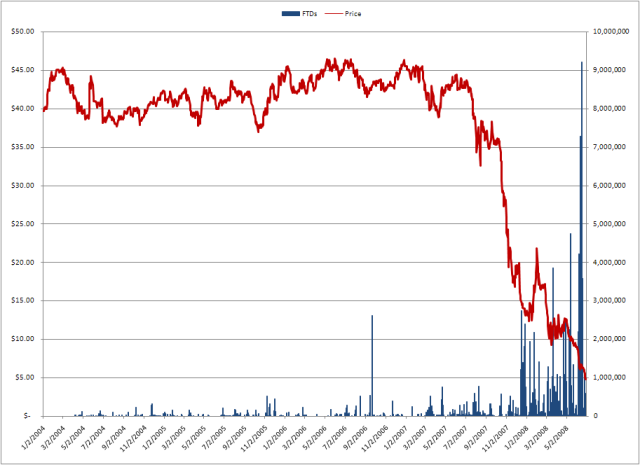
An FTD happens when the person purchasing a stock does not receive the stock purchased. The FTDs in the collapse of WaMu are phantom shares. The ability of brokerage firms to create phantom shares added 50% to the decline in the stock accelerating the demise of WaMu.
As noted in Disciplined Shorts, there are two ways to cause an FTD. You can sell a stock without bothering to locate the a share to sell. Or you borrow a share, and that share gets sold before you buy back.
It is a joke that such a system happens in this world of real time communications. The regulators have rigged the game to transfer massive sums of capital from investors to hedgefunds and brokers. The system of regulations that have been designed jointly by our Democratic and Republican leaders is the leading cause of the growing gap between rich and poor.
BTW, I am not impressed by the fact that Warren Buffet is Obama's advisor as he has proven to be adept at manipulating the system to his advantage. Buffet's game is that of a takeover artist. I would want an advisory board with people whose primary concern is building and creating new technologies, rather than people skilled at taking over the creations of others.
Centralization
In the first presidential debate, Barack Obama did a great job framing the mortgage crisis as one of regulation v. deregulation.
Republicans would be wise to reframe the issue as a question of centralization v. decentralization. FannieMae and FreddieMac were creations of the New Deal which effectively centralized the mortgage industry by giving a tacit understanding that the mortgages were backed by the US taxpayers.
The centralization created this strange thing that unified all of the mortgage markets across the country (and even parts of the world) into one big top heavy market.
The fault of the Republicans is that they failed to realize that centralization is a worse problem than regulation. They were happy to privative the centralized regulatory market; however that market was inherently instable. To make deregulation work, one most completely break the centralized regulatory mechanisms.
Obama's claim is that a regulator jumping up and down on the starboard side of the centralized mortgage market could keep it stable. The truth of the matter is that no markets are ever stable.
Rebuilding the centralized regulatory mechanism might give a moments sense of stability; however, we are just setting ourselves up again for a new crash.
Rather than rebuilding the economy based on tools for a rigid economy. We should realize that markets are fluid and transition our economy from rigid investment tools like mortgages and interest bearing loans to securities that share risks and equity in a fluid market.
Friday, September 26, 2008
The Blame Game
The pundits are wrong. I keep hearing people who frame the bailout as a case of evil investors taking unnecessary gambles, and that society as a whole must now pay for those gambles.
The problem is the opposite. In recent years the market has been driven by an investment paradigm designed to eliminate risk. The investment community has been driven by banks and investment funds trying to get out of risky things like stocks and into secured investments like government backed mortgage securities.
Corporate investment of late has been driven by a new type of investor called a hedge fund. By definition, a hedge fund is a group of people using a mix of equities to hedge their risk. Like other banks, their formulas rely heavily on leveraging government backed mortgages.
Don't you see? The market was not driven by people seeking risky investments! The market was driven by people looking for hedged investments reinsured by the Federal Government. There was a tremendous demand for government backed mortgages to suit the myriad of investment schemes created by risk adverse banks and hedge funds. The mortgage companies responded to and filled that need.
Driven by aversion to risk, leading investors and hedge funds have essentially pulled their equity out of the market and have it locked in trading strategies designed to hedge risk.
The only possible boogeyman in the situation is the frontline mortgage agent who bought the line that they were helping people live the American dream by putting them in a house they could not afford.
It is possible to lay blame for the dotcom bust on the irrational exhuberance of risk takers. The crash of 2008 is a crash driven by aversion to risk.
For example the mark to market accounting rules is causing businesses to fail that actually have a healthy mix of equities but are just suffering from the fact that no-one is currently buying equities.
The reason I've been pounding out blog posts about securities like mortgages and short orders is to show how our financial institutions are building houses of cards on securities which are simply too far divorced from reality to be stable investing tools.
We need to realize that our current problems are driven by the mix of tools on the market. The blame is not with the people.
Thursday, September 25, 2008
Bailout Plan
I am happy to finally see a few Republicans openly acting like Republicans and voicing loud opposition to the bailout plan. I wish they had been louder in the demand to reign in FreddieMac and FannieMae. Yes, the cartoon characters were creations of FDR making them sacrosanct to the believers of the Democratic Party think; however failure to let opposition be known created the opportunity for the media to frame the programs as creations of George W. Bush.
I think Bush made a big mistake in trying to position the bailout as a creation of his administration when the creation currently being considered is actually quite bipartisan. Perhaps the most important part of the art of compromise is that one needs to let the opposition share claim. On that note, McCain has a history of sharing credit on legislation.
IMHO, in a healthy system of discourse, people would very clearly express uncompromised versions of their ideas. When making compromises with the opposition, they would share credit while letting the nature of the compromise be known. Perhaps the best example of a compromise is the 3/5th rule. Opponents to slavery weren't able to resolve the issue. Realizing that slaves would not be allowed to vote, they pushed an absurd compromise that slaves would count as only 3/5th a person in the enumeration used to distribute Congressional districts.
I think one of the reasons that Bush comes off as so uncompromising to the public is that he keeps positioning compromises as his creation.
I am really happy to see Republicans coming out and sounding like Republicans.
Unfortunately, I think Congress has no choice but to pass the silly bailout program and get to work buying up the "toxic mortgages" to restore liquidity to the market.
I happen to believe in people. Most people work hard to pay their debts. As such, I supect that the "toxic mortgage" portfolios are worth more than the current market price. I suspect that the true value of the portfolios lies somewhere between the current market price and the book price.
The reason the Federal Government has to get involved in the bailout is that FDR's bastard children FannieMae and FreddieMac made the financial world a tacit promise that big daddy federal government would back up the loans. Failure to live up to this promise would have long term ramifications.
Now that FannieMae and FreddieMac are officially listed among the failed New Deal programs, I hope that our society undergoes a deep conversation about the nature of mortgages and how mortgage financing inherently instable and that we need a mechanism where the property owner and lender share the equity and risk related to a property rather than this system that forces an onerous burden of debt on the public.
Subscribe to:
Posts (Atom)