Monday, June 29, 2009

New Photo Blog

Last week I created a photo blog for the ProtoPhoto.com Gallery. The primary reason for making the blog is that I wanted to have an RSS feed for the photo site. My goal is to featured a new picture every day.

If people added the feed to their reader, they would get a random photo each day.

Several of first posts were about a walk I took through downtown Salt Lake City while my car was in the muffler shop. This is a good time to take photos of the city as there's a large number of gaping holes created by the current construction frenzy.

Below are some of the photos from the walk:

222 South Main ~ Grand American ~ phto ~ Construction Time ~ Construction Time

The Deep Capture of Dendreon

Deep Capture is serializing an account of the Naked Short Attack Against Dendreon. It is high drama in the financial world as the ruling elite at NBC, hedgefunds and regulatory agencies take down a promising cancer treatment ... making huge financial gains.

The article is critical of a regulation built into the market called the "Madoff Exception." This exception was named for a little known progressive businessman named Bernard Madoff. Madoff was instrumental in establishing the internal regulating mechnisms within NASDAQ. He later created a high profile hedgefund manager who operated accounts for many high profile foundations, and investors.

The Madoff Exception essentially allowed market makers to sell large quantities of stock without actually owning a stock.

The justification for the regulation is that it assures liquity in a stock. (A very flimsy argument as scarcity is the only true value of any asset.)

I contend that the Madoff Exception (and other forms Naked Short Selling) are fundamentally at odds with the concept of property.

Ownership, after all, is a temporal phenemena. No-one owns any tradeable asset in perpetuity. We own the asset from a purchase to a sale. We gain or lose on a asset based on how the market fares during our term of ownership. The Madoff Exception gives an elite ruling class the ability to sell a fake asset during the duration of ownership. This fake transaction is a taking.

Defenders of short selling claim that they have a fundamental right to buy or sell any given equity at any given moment. This fake right is fundamentally opposed to property rights wherein only the property owner has rights of ownership. You don't own your house if someone else has the right to sell it!

In the financial tools revolution we saw hedgefunds and other insiders build enormous fortunes by taking huge short positions, then trading these short positions as if they were an asset. These tools eventually grew to the point that they wiped out the whole market.

I applaud Patrick Byrne of Overstock.com for their diligence in reporting on this issue. Simply because a market involves a exchange and people making trades does not mean the market is a free market. Bernie Madoff and other elitists who "regulate" these markets are more than happy to trade away our freedoms.

'nough said, the new deep capture piece is a good read.

Sunday, June 28, 2009

A Broken Regulator

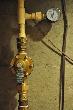
Under PressureYep, I am slow at figuring things out. Anyway, we finally figured out the source of our plumbing problems. It was a bad regulator.

To figure out that the regulator was bad, we had to first replace the pressure gage. The gage was stuck on 70psi. It was totally full of calcium build up.

Having replaced the gage, we discovered that the water pressure was 126psi. My guess is that, with the unusual wet Spring, the water system is cranking at full capacity.

Rose in the RainReplacing the valve was another big repair expense. With income dropping like a rock, this quarter was deeper in the red than normal.

On the bright side, the deep rain gave me another shot at photographing a waterlogged rose a few days back.

Saturday, June 27, 2009

Contrived Markets

I've long favored a tax system that moved tax burdens from labor to resource consumption. One can argue that natural resources (especially air) are public goods. Gasoline works by combining gas with air to produce energy. People pay for the gas, but not the air. As we are all using the same air, it makes sense to tax gas for the amount of air consumed.

Many experts favor a system called cap and trade.

The experts argue that cap-and-trade works somewhat like the free market. Policy makers would establish social and environmental goals, then companies would buy and sell abstract entities as they try to achieve the stated goals.

To be honest, I think that large contrived markets designed to resemble the free market are far more damaging to the market that cleanly stated taxes. The contrived markets give the inside players the ability to make out like bandits as they adjust the rules. When the market fails, they blame the free market.

Look at the way our gas prices get thrashed about by the speculative market in oil.

The implosion of the mortgage market in 2009 provides another great example. Two GSEs name Fannie Mae and Freddie Mac had used their role as government backed insurers to define the market. This caused a bubble in housing and lined the balance sheets of banks with toxic assets.

In the wake of the fiasco with the Credit Default Swaps, I wish that Congress would just slam the brakes on the cap and trade and go with the much more straight forward option of raising taxes on natural resources.

Just because a system has competitive elements and trading does not mean it is a free market. Any market that begins with politicians sitting behind closed doors to set social objectives is not a free market. Systems that start with the government and trickles down to the people is a fascist economy, not a free market.

The drum I want to pound is that freedom is the key element to the free market.

Professors, pundits and politicians seem to fall for the line that if something involves people making trades on an exchange that it must be a free market.

Not long ago, white people were buying and selling black people on the market. People made loans on slaves and even bred their fellow man for the market. Slave trading is the antithesis of the free market.

Simply because a system involves trading does not mean that it is a free market solution. In cap-and-trade, people are trading a contrivance of regulators. It appears to be a very dangerous direction to follow. A trillion dollar cap-and-trade program could easily turn into a bubble … just as credit default swaps did last year.

In 2008, we saw the contrived markets swamp the entire economy. Predictibly, when these contrived markets implode, pundits turn their anger toward the free market.

Returning to the discussion of the free market: The key element of the free market is freedom. The classical liberal tradition found that freedom is best enhanced by having a clean straight forward set of rules centered on property rights.

The ten thousand page bill that created and regulated Credit Default Swaps was anything but straight forward. The ten thousand page bill creating cap and trade equally convoluted.

Even worse, as the system is driven by social engineers masquerading as environmentalists, the rules are apt to change as the engineers experiment with ways to re-engineer with society.

Thursday, June 25, 2009

Insurance and Corporate America

I don't hate corporate America.

Reading progressive blogs, I can't help but notice that a large number of people seem to be supporting Obama's health plan because they hate corporate America. There seems to be an even deeper hatred aimed at insurance companies.

I dislike politics motivated by the desire to punish enemies and reward friends.

I would rather see politics aimed at a discussion about finding the best solution for all people.

If I were motivated by hatred of corporate America and sought to implement health care reform in a way that would do the most harm to my enemy … well, I would favor Medical Savings Accounts. I would be thrilled tickled with the idea of a medical savings and loan.

It is the war chests of insurance companies, more than anything else, that fund the truly big and corrupt aspects of the corporate world.

The MSAs and the MS&L would actually take all of that money and power and redistribute it to the holders of the accounts.

The MSAs and MS&Ls are superior to insurance in that people actually develop equity in their accounts. This equity has two positive effects: The first is that it provides better security for workers (you have equity in an MSA when you leave your job). The second positive effect is that the wealth in the MSAs could help redistribute economic power.

The MSAs would be a remedy to the highly centralized corporate and political structures that have calcified our economy.

While I think making decisions based on hatred is a bad idea, I would like to ask those driven to destraction by Corporate America to parse their hatred and ask: Is is the centralization that you hate? Is it the ownership of private property, or perhaps is the source of the hate a wealth envy sort of thing?

If it is the centralization that drives you to distraction; then I would like to point out that moving in the direction of the MSA does more to decentralize the system than any other option. The various plans put forward by Obama, Romney will have the effect of greater centralization.

Notice how the biggest of the big insurance companies are locked in step with the so-called reform bills.

Conversely, I think one would find evil parts of corporate America would be more resistant to a president who was authentically engaged in making MSAs the standard for health care than they are to the various forms of mandated health care on the table.

Wednesday, June 24, 2009

Conflicting Talking Points

I've heard the following talking points in several speeches … Including the health and human service secretary, the president and several democratic lawmakers.

The first is an emphasis that the status quo is not acceptable.

The second talking point is that the current drive for a more progressive health care system is not something new. It is a process that has been underway for several decades. Different politicians say 50 years, others say 60.

If the American people applied just a small amount of reasoning to the health care situation they would realize that the unsatisfactory status quo is the result of decades of progressive politics.

Fifty years ago, progressives invested their clout in selling the notion that we should fund health care through pools rather than individually.

Today, progressive politicians simply dismiss the idea of people having a direct relationship with their doctor. Despite the fact that insurance agents are removed from the administering of care, the intelligentsia has successfully equated the term healthcare is equated to insurance. Not having insurance is equated to not having healthcare.

The new healthcare plan introduces a public option. The government will own and subsidize a massive chunk of the healthcare pie. At the same time the government will regulate its competitors. We are supposed to believe that the enlightened politicians would not use their power to regulate their competition, will not abuse their power to drive their competition under.

I guess the response to the first two talking points is for Libertarians to try and interject the talking point that the progressives are the creators of the unsatisfactory status quo.


Americans are happy with the medical care in this nation. We abhor the funding mechanism. This funding mechanism was the product of decades of progressive thinking and scheming.

Why should Americans want to give more power to the very politicians who created such a dysfunctional system in the first place?

Saturday, June 20, 2009

The Basij

Mental note: The name of the name for the political enforcment group that is beating up the post election protestors in Iran "Basij" (as reported by The Australian News.

I wonder how many of the people who joined the Basij did so thinking that they would be part of a progressive group advancing social justice in Iran.

Friday, June 19, 2009

Equity not Interest

My two proposals for financial reform are: Shared Equity Financing and adding a loan component to medical savings accounts ... making a Medical Savings and Loan.

The common thread for these two reforms is that they focus on building equity while finding alternatives to interest.

Western history is full of economic collapses caused by loans falling out of sync with the equities backing the loans.

For example, a mortgage is a margin play against real estate. We saw in our current economic crisis that a drop in housing prices put a large number of home owners "underwater." Their home is worth less than the loan against the home.

The primary goal of a regulatory regime is to keep loans in sync with equities. The alternative is to find alternatives to interest bearing loans.

The interest on a loan is simply a premium that a lender pays to access money. Interest bearing loans add the premium to the payments.

The medical loans that I outlined in previous post approach the premium from a different angle. Rather than backloading the premium, it frontloads the premium. People owning a medical savings account will pay a premium to have access to a guaranteed medical loan that would cover a gap between their savings and high deductible insurance.

As the premium was paid in advance, there is no reason that this loan should bear interest.

Shared Equity Financing is an alternative to traditional interest bearing mortgages. Rather than borrowing a fixed amount of money against the house, the property owner takes out a percent based lien against the property. This lien would track local property values. The liens would be purchased by entities wishing to invest in real estate.

Both reforms are designed to help individuals build and maintain equity. The MSL program encourages individuals to build equity in their medical savings account. Shared Equity Financing helps people regulate their exposure to the local realty market. A traditional mortgage is a margin play. You have a loan of a fixed amount tagged to a property of a variable amount. In such a scenario, one never really knows how much equity they have. A shared equity lien is percentage based; So, the homeowner would know with certainty the percentage of the home that they own.

Our financial system collapsed as it was based on extremely complex formulas that tried to shield investors from risk.

I believe that the real quality of a financial instrument lies in its ability to reflex the equity behind the instrument. Before imposing a new regulatory regime, I think we would be wise to develop financial tools that better reflect the equity in our economy.

Thursday, June 18, 2009

Regulatory Mindset

President Obama's speech on regulatory reform was less painful than I had feared. I was hoping that Obama would have given us more details on the plan. Instead his briefing was more like the vague political posturing used by the Neocon Phil Gramm (R-Texas) back in the Clinton era to sell us on Credit Default Swaps.

The speech had many good points. For example, Obama dislikes the horrifically complex mortgages with pages of fine print that few can understand. This section of the speech would be welcome if not for the fact that it was given by a person with a track record or jamming through extremely complex legislation rife with fine print that few understand.

The turn in the speech that I liked was that Obama did not say our problems were the result of the last eight years (he said they were the results of decades of thinking). He also did not blame economic woes on "deregulation."

Unfortunately, I fear that the leaders of this nation (both R and Ds) have realized that our problems are not simply with the regulations in place, but with the way that we think about the economy.

Obama's speech establishes risk management as the primnary concern of the economy.

In reality, the central focus of the economy should be the building of equity coupled with people the living happy, fulfilled lives.

This process of created a hugely centralized government justified by risk management concerns is precisely the wrong direction.

Don't you see? The whole point of Credit Default Swaps, the mortgage backed securities, the government backed re-insurance, the short selling, the hedge funds, and the myraid of other complex financial instruments was an ill fated effort to create a set of financial tools that would set up a ruling class.

To truly solve the problem we need to root deeper and find the problem with our thinking that made risk management, opposed to building equity, the primary concern of our economy.

Wednesday, June 17, 2009

MSLs in a Multidimensional World

There are many tests, vaccines and procedures that doctors, employers, government agencies or insurance companies want people to have that people would be hesitant to pay for out of cash.

For example, an employer, desiring a healthy work force, may want employees to get regular check ups. The employee might prefer letting this money build up in their savings account. The government might want everyone to get a vaccine to eradicate a disease. Doctors might want patients to take tests that provide information for the doctor's private research. Insurance agencies might want people to take additional tests because the extra tests reduce liability costs.

One can very easily accommodate these desires by subsidizing the procedures.

For that matter, if you pay attention, you will notice that a great deal of activity like this already takes place.

The medical savings and loan could become a conduit for formalizing such subsidies. For example, an employer could have payments to the employee's account set up so that it funds a yearly check up. The government already gives free vaccines in cases where they are trying to stop an epidemic. Pharmaceutical companies pay people to be test subjects, and foundations can subsidize procedures related to their given cause.

The heart of the free market is freedom. The free market enables individuals and groups to do what they want to do with their resources.

This observation on freedom leads into an observation about medical savings account.

When speaking of a medical savings account one imagines a system where a person suddenly needing care would draw down their savings for medical expenses first. If that is not enough, they take out a loan. Finally, if medical expenses veer too far off the norm, the funding for the care comes from insurance.

A truly robust medical savings and loan program would seek funding from multiple sources from the offset. A robust system would seek to prevent situations where a single medical problem exhausted the savings account. For example there might be a low deductible for certain accidents, or one might have a graduated deductible, for example a patient would pay 90% of the first $1000 in expenses, 80% of the second grand, 70% of the third grand, and so on.

The repayment of the loan would use a graduated approach as well. Our knee jerk reaction is that one should pay off loans first, then establish savings second; However, the MSL might be rigged so that half of future payments go to pay down the loan, and half goes into savings. This is just an accounting trick. But it has the positive effect of assuring the owner of an MSL account that they continue to have resources available for medical expenses even when they are in the red.

Once the basic structure of the MSLs is in place, I am sure that people will find all sorts of ways to make the system meet both the objectives of the individual and of the different players involved in health care.

The MSL structure does not deny the multidimensional nature of our world. What it does is give individuals direct equity in their health care.