The Utah Taxpayer has a bizarre post. They say that sales tax structures create a false economy where cities prefer to have retail stores move in than industy. This helps explain why there is so much RDA money sunk into building Malls and Walmarts, while real industry is left to sprawl on its own on the outskirts of town. The industry may bring in more money into the community. The retail store brings in sales tax directly into the pocket of the city.
This weird economy leads to strange behavior where cities give incentives to retail, and throw up zoning challenges to manufacturing.
The post has a great quote: "Retail happens on its own. It does not need to be subsidized."
To a large extent, retail has a zero sum gain. Pulling a new store into the Salt Lake Valley really doesn't bring in that much new money. The new store might shuffle sales tax dollars between the municipalities in the valley, but does not bring in much new wealth.
Now, I do understand that not all retail is a zero sum gain. Local First notes that locally owned stores tend to keep a higher percentage of consumer money in town because both salaries and profits stay in the community.
A city planner, however, who is only looking at sales tax revenue may not take into the account the positive effects of local ownership. Sales tax from a chain store looks just like sales tax from a locally owned business. City planners just looking at sales tax would see that local stores are already there. So, he-she-or-it would be tempted to spend some of the taxes collected from local businesses to attract in remotely owned competition. Every city planner knows that the city that gets the Walmart gets the sales tax revenue.
Showing posts with label planning. Show all posts
Showing posts with label planning. Show all posts
Tuesday, February 13, 2007

Friday, December 15, 2006
Preserving Main Street
I love the traditional American Main Street lined with independent shops hawking their independent versions of the American dream.
Conversely, I dislike the sprawling soulless American suburbs with cookie cutter strip malls and box stores.
Needless to say, I’ve been greatly disappointed to see that the majority of growth that has occurred during my lifespan has happened in the suburbs. In most cases, the downtowns that I loved as a youth are less than they were when I was born.
The sprawling suburbs have consumed a large portion of the farmland and open space that excite the imagination and charge the soul.
For that matter, one of the primary reasons that I’ve wasted time creating community directories has been an interest in finding ways to preserve the great traditional cultural centers of America that I strongly believe are important to the American psyche.
Anyway, while surfing through the net today, I happened on two interesting sites. The first is the American Independent Business Alliance (AMIBA) from Bozeman, Montana. This organization proclaims the importance of supporting local independent businesses. (Something that my little directories do, and do quite well).
I digging through the various AMIBA sites, I found that many were intensely involved in efforts to preserve traditional main streets such as the Colorado Preservation Council.
My brain began juxtaposing two ideas: Supporting independent businesses and preserving Main Street.
It finally dawned on me what was wrong. The two ideas are oppositional.
Traditionally, Main Street has been the most dynamic, happening and changing place in a city. The reason that people used to flock to Main Street was because it was the happening place that was constantly changing. People used to flock to Main Street to see what was new, innovative and exciting.
The precipitous decline in Main Street began when preservationist councils and aggressive zoning boards started the process of hyper regulation of growth in downtown. Sadly, in most cases, the goal of the zoning board is to preserve the market share of a few powerful players in a city. While zoning boards have proven incapable of attracting business and people to an area, they are extremely adept at shielding powerful concerns in a city from competition.
The goal of preservation councils is generally to stop growth and preserve the character of an area as it existed at some point in the past. The goal of the preservationist is simply soak the town in bureaucratic formaldehyde; so that the downtown will never change. The fact that such sterile environments are neither conducive to the growth of business or to the public at large does not matter.
The traditional American Main Street is not simply an architectural style that existed at a given period of time. Main Street is a process of continual change. If Main Street is first and foremost a process of change, then the very cry to preserve Main Street is an oxymoron. How do you preserve an entity when change is the central to the nature of the entity?
If we really want to renew our downtowns, we need to find ways to reignite the process of continual renewal that defined the traditional Main Streets. We need to get back to the world where we see Main as a center of innovation, growth and improvement, and not as an ideal that existed in the past, that has been lost.
To preserve the dynamic character of downtown, we need to break from the modern mind set that values preserving old buildings to one that preserves the beating heart of Main. That living, beating heart demands continual growth and change.
The Planning commissions are not the ally of small business. Planning and preservation committees are the primary enemy of growth and small business.
Conversely, I dislike the sprawling soulless American suburbs with cookie cutter strip malls and box stores.
Needless to say, I’ve been greatly disappointed to see that the majority of growth that has occurred during my lifespan has happened in the suburbs. In most cases, the downtowns that I loved as a youth are less than they were when I was born.
The sprawling suburbs have consumed a large portion of the farmland and open space that excite the imagination and charge the soul.
For that matter, one of the primary reasons that I’ve wasted time creating community directories has been an interest in finding ways to preserve the great traditional cultural centers of America that I strongly believe are important to the American psyche.
Anyway, while surfing through the net today, I happened on two interesting sites. The first is the American Independent Business Alliance (AMIBA) from Bozeman, Montana. This organization proclaims the importance of supporting local independent businesses. (Something that my little directories do, and do quite well).
I digging through the various AMIBA sites, I found that many were intensely involved in efforts to preserve traditional main streets such as the Colorado Preservation Council.
My brain began juxtaposing two ideas: Supporting independent businesses and preserving Main Street.
It finally dawned on me what was wrong. The two ideas are oppositional.
Traditionally, Main Street has been the most dynamic, happening and changing place in a city. The reason that people used to flock to Main Street was because it was the happening place that was constantly changing. People used to flock to Main Street to see what was new, innovative and exciting.
The precipitous decline in Main Street began when preservationist councils and aggressive zoning boards started the process of hyper regulation of growth in downtown. Sadly, in most cases, the goal of the zoning board is to preserve the market share of a few powerful players in a city. While zoning boards have proven incapable of attracting business and people to an area, they are extremely adept at shielding powerful concerns in a city from competition.
The goal of preservation councils is generally to stop growth and preserve the character of an area as it existed at some point in the past. The goal of the preservationist is simply soak the town in bureaucratic formaldehyde; so that the downtown will never change. The fact that such sterile environments are neither conducive to the growth of business or to the public at large does not matter.
The traditional American Main Street is not simply an architectural style that existed at a given period of time. Main Street is a process of continual change. If Main Street is first and foremost a process of change, then the very cry to preserve Main Street is an oxymoron. How do you preserve an entity when change is the central to the nature of the entity?
If we really want to renew our downtowns, we need to find ways to reignite the process of continual renewal that defined the traditional Main Streets. We need to get back to the world where we see Main as a center of innovation, growth and improvement, and not as an ideal that existed in the past, that has been lost.
To preserve the dynamic character of downtown, we need to break from the modern mind set that values preserving old buildings to one that preserves the beating heart of Main. That living, beating heart demands continual growth and change.
The Planning commissions are not the ally of small business. Planning and preservation committees are the primary enemy of growth and small business.
Tuesday, April 04, 2006
House Thinking
I am listening to talking heads on the radio about a new book called House Thinking by Winifred Gallagher. The book is based on historical research on ways that we think about the rooms in our house.
Most of the redesign discussion I've heard in the last several years have dealt primarily with the effects that the redesign has on the resell value of the house, taxes or on the all important mortgage. The discussion of how we actually live in the house takes second stage. For example, today people are spending outrageous amounts on kitchen redesigns ... this is happening at a time when people are doing less cooking.
Of course, we are not unique in building our houses around false ideals. The reasons houses of 50 years ago were split into many different rooms is that the number of rooms was a primary factor in the selling price of a home.
House Thinking sounds like an excellent contribution to the overall dialogue about how we should organize our lives in this modern world.
Most of the redesign discussion I've heard in the last several years have dealt primarily with the effects that the redesign has on the resell value of the house, taxes or on the all important mortgage. The discussion of how we actually live in the house takes second stage. For example, today people are spending outrageous amounts on kitchen redesigns ... this is happening at a time when people are doing less cooking.
Of course, we are not unique in building our houses around false ideals. The reasons houses of 50 years ago were split into many different rooms is that the number of rooms was a primary factor in the selling price of a home.
House Thinking sounds like an excellent contribution to the overall dialogue about how we should organize our lives in this modern world.
Friday, March 31, 2006
New Orlean's List of Enemies
The Christian Science Monitor reports that a geological fault might number among New Orlean's enemies. The article suggests that about 6 feet of New Orlean's sinkage in the last century might be the result of geological movement.
It seems to be the nature of this planet that parts of the earth go up and down. Glaciers advance and recede, floodplains fill up and drain. Volcanos go boom.
In such a world, one would expect to see an occasional loss of a city.
Of course, Suggesting that we not rebuild the "Chocolate City" would be racist. Yes, I wouldn't want to locate a business there, but we can have a major city where everyone lives on the government's tab. The free market's response to geologic change is migration. I guess that can be taken as yet another sign of why the free market has failed and should be avoided. I still can't help but wonder what, if any sign, we humans should take as an indication that a city must be abandonned?
It seems to be the nature of this planet that parts of the earth go up and down. Glaciers advance and recede, floodplains fill up and drain. Volcanos go boom.
In such a world, one would expect to see an occasional loss of a city.
Of course, Suggesting that we not rebuild the "Chocolate City" would be racist. Yes, I wouldn't want to locate a business there, but we can have a major city where everyone lives on the government's tab. The free market's response to geologic change is migration. I guess that can be taken as yet another sign of why the free market has failed and should be avoided. I still can't help but wonder what, if any sign, we humans should take as an indication that a city must be abandonned?
Tuesday, March 21, 2006
In Praise of Thrift
Apparently, The Draper City Council wants to keep a thrift store from opening in their commercial core (SL Tribune -- broken link). The fear is that a large Deseret Industries store would sully the town's elitist image as an upper middle class haven.
IMHO, this type of aggressive zoning and regulations on who and what is allowed in our towns is exactly the problem that threatens the long term viability of our communities. I disagree 100% with the Draper City Council. Property owners in a commercial district should be able to put up whatever store they think will best serve their public without this micromanagement and judgment of politicos.
I happen to like thrift stores. I've spent a fair amount of time watching the evolution of communities in the internet age. One of the really interesting trends in the last several years is a growing interest in used items. There are two things that feed this. The dominance of box stores has made a tough climate for the small mom and pop type of shop that used to line main street. The second big factor is online auctions. A large number of Utahns supplement their income with eBay stores. This market where we can buy, sell and trade used goods totally transforms the perpective of a buyer.
People who get hooked on eBay are no longer just interested in buying cheap goods that they will toss out. eBayers turn from pure consumers to buyers and sellers. This new type of consumer has the potential to transform the marketplace because buying used is now chic.
While the Draper City Council might be trapped in an elitist vision that thrift stores are only for poor inner cities, I personally, I see thrift stores has having a very positive effect on the community. It is something that belongs in all communities.
This statement might seem bizarre to zoners, but I think that thrift stores actually end up contributing more to the local community than most other types of store. This idea would seem bizarre to planning commissions because the planning commissions look only at the tax revenues.
If you look at a community as a whole system, you get a different picture. What thrift and antique stores do is they take used items from within a community and resell those items to the community. Thrift stores are a closed system. All of the money spent at the thrift store stays in the community.
The big box stores that planning commissions tend to favor have the opposite effect. The typical big box store is owned out of state. They get their product from China. While the big box store might generate more tax revenues, the end effect of big box stores is they take price of the goods and the profits from the sales out of the community.
Thrift and antique stores end up doing one other really bizarre thing. When people see themselves solely as consumers, they end up with a trailer park mantality where they buy cheap stuff destined for the landfill. When people see buying and selling as a cycle, they end up buying higher quality of goods that have resell value. If you develop a system like the antique row in Denver, you end up creating a economic landscape where people actually have equity in the things they own ... which makes for a more stable and wealthier society.
While big box retailers become more and more distant from our community, I suspect that this trend my spawn another trend of more community owned thrift stores and antique shops.
Of course, the biggest enemy of this trend is the zoning commissions that lust after tax dollars. The political drones that haunt the halls of power tend to create tax and zoning policies that put thrift stores and used good stores at a distinct disadvantage.
The idiots on the zoning council probably do not see this. They would look solely at the tax revenues.
IMHO, this type of aggressive zoning and regulations on who and what is allowed in our towns is exactly the problem that threatens the long term viability of our communities. I disagree 100% with the Draper City Council. Property owners in a commercial district should be able to put up whatever store they think will best serve their public without this micromanagement and judgment of politicos.
I happen to like thrift stores. I've spent a fair amount of time watching the evolution of communities in the internet age. One of the really interesting trends in the last several years is a growing interest in used items. There are two things that feed this. The dominance of box stores has made a tough climate for the small mom and pop type of shop that used to line main street. The second big factor is online auctions. A large number of Utahns supplement their income with eBay stores. This market where we can buy, sell and trade used goods totally transforms the perpective of a buyer.
People who get hooked on eBay are no longer just interested in buying cheap goods that they will toss out. eBayers turn from pure consumers to buyers and sellers. This new type of consumer has the potential to transform the marketplace because buying used is now chic.
While the Draper City Council might be trapped in an elitist vision that thrift stores are only for poor inner cities, I personally, I see thrift stores has having a very positive effect on the community. It is something that belongs in all communities.
This statement might seem bizarre to zoners, but I think that thrift stores actually end up contributing more to the local community than most other types of store. This idea would seem bizarre to planning commissions because the planning commissions look only at the tax revenues.
If you look at a community as a whole system, you get a different picture. What thrift and antique stores do is they take used items from within a community and resell those items to the community. Thrift stores are a closed system. All of the money spent at the thrift store stays in the community.
The big box stores that planning commissions tend to favor have the opposite effect. The typical big box store is owned out of state. They get their product from China. While the big box store might generate more tax revenues, the end effect of big box stores is they take price of the goods and the profits from the sales out of the community.
Thrift and antique stores end up doing one other really bizarre thing. When people see themselves solely as consumers, they end up with a trailer park mantality where they buy cheap stuff destined for the landfill. When people see buying and selling as a cycle, they end up buying higher quality of goods that have resell value. If you develop a system like the antique row in Denver, you end up creating a economic landscape where people actually have equity in the things they own ... which makes for a more stable and wealthier society.
While big box retailers become more and more distant from our community, I suspect that this trend my spawn another trend of more community owned thrift stores and antique shops.
Of course, the biggest enemy of this trend is the zoning commissions that lust after tax dollars. The political drones that haunt the halls of power tend to create tax and zoning policies that put thrift stores and used good stores at a distinct disadvantage.
The idiots on the zoning council probably do not see this. They would look solely at the tax revenues.
Friday, March 17, 2006
A Tale of Two Shopping Districts
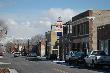 A recent trip brought me through Magna, Utah. Being on the west end of town, I decided to check out the sprawl in the Southwest areas of Salt Lake County. I ended up visiting the large Jordan Commons shopping district.
Magna is a small blue collar town near the Kennecott Copper Smelter. The town is a beautiful example of some of the early thinking that went into town planning. The basic ideal of the day was that of a Main Street lined with independently owned shops. The center of town had a wonderful collection of small starter homes, a few free standing fourplexes and larger homes for well established families. Magna, itself, is within walking distance to the big chainlink gate that surrounds Kennecott.
To my dismay, about half of the shops in this traditional shopping district were boarded up and closed.
 The Second part of my excursion brought me to the Jordan Landing. Jordan Landing is a new shopping concept. A good description might be a Mall on Steroids. A traditional Mall has a combination of anchor stores and smaller clingon stores in a connected enclosed space surrounded by an massive shared parking lot.
The Jordan Landing is more like a strip mall with free standing box stores. The Landing includes the first Sears Grand store, a Sams Club, Walmart, Kohls, Lowes, Circuit City and a string of other traditional free standing stores. The Landing also has a large number of free standing chain style restaurants. The stores are in an area that is almost 2 miles square. Most people, I suspect, drive from store to store.
Regardless, the area was packed. Here we are in the middle of March (not a big shopping season). The massive parking lots were close to half full and people were walking out of all the stores with big carts brimming over with goods.
In part what is going on is a major demographic switch. Unlike downtown Magna and Salt Lake City proper, West Jordan is expanding. The population of the West Jordan is currently something like 85,000. It is projected to grow to 185,000 within the next several decades. I suspect that central Magna (like Salt Lake City) is seeing its population decrease. The Salt Lake City zoning commission is extremely hostile to new businesses and growth. The result is that the natural population growth in Utah can only find housing through sprawl. In 2000, Salt Lake City's population was 181,743. The 2004 estimate is 178,605. Within the next thirty years, West Jordan, West Valley City and Saint George will all have larger populations than Salt Lake City.
The box store concept has many advantages. The selection is greater. Prices are less. Generally towns put a high sales tax on sales in traditional shopping districts.
It is hard to say if the phenomenal success of Jordan Landing is due to this demographic switch or if there really is something about the free standing box store concept that is innately appealing to the American mind.
Looking at Jordan Landing, I do wonder how well the concept will carry through the ages. If the current success is due only to demographic trends, the area might start to languish in the next 40 years or so. I suspect that the founders of Magna thought that they were building a downtown shopping district that would be thriving centuries into the future.
Comparing the blight in downtown Magna to the thriving success of Jordan Landing. I can't help but think that the real secret to long term success is slow sustained growth. Traveling through Europe several decades ago, I noticed that vibrant cultural centers had a long history of buidings being torn down and rebuilt as the area grew.
What the US has done with the our current cities is to create a political structure that is hostile to this sustained growth. A businessman who wants to expand a small business in Salt Lake City can't because the drones on the zoning commission. The truth in business, is that if you can't grow, you can only languish.
The aggressive zoning that dominates traditional downtowns creates this destructive cycle of blight followed by government subsidized urban renewal. Meanwhile, the people sprawl into the countryside because that is the only place were growth is allowed.
Wednesday, October 05, 2005
Lift Ogden
Perhaps the most interesting debate going on in Ogden is about the future of mass transit in the area. Ogden is a railroading town near the Golden Spike. The town loves its train station and there is a great deal of support for commuter trains. A commuter train to Salt Lake could pull some of the traffic off the bottleneck near Farmington.
 While the city's history favors trains and light rail, there also an innovative idea of building a system of Gondolas in Ogden (Lift Ogden has a PDF on the Gondolas). Gondolas take advantage of the third dimension. Intercity Gondolas would be more convenient and faster for intercity transportation since a new Gondola would show up every
The Sierra Club opposes the Gondola as it would bring more people and the need for more services into the Wasatch. Since a gondola would lift people above the fray, it would increase overall appreciation of the beauty of Ogden.
Personally, I would favor mass transit devices leading into the Wasatch. A Gondola would help encourage people to leave their vehicles behind. As much as I love the train, I think the future of mass transit will be with smaller compartment sized people movers that allow for more customized transit.
Think about this for a moment: What is the most popular mass transit device in America? My guess is that elevators move substantially more people each day than trains. Our perception is that elevators conform to the needs of people while people have to conform to the needs of train.
While the city's history favors trains and light rail, there also an innovative idea of building a system of Gondolas in Ogden (Lift Ogden has a PDF on the Gondolas). Gondolas take advantage of the third dimension. Intercity Gondolas would be more convenient and faster for intercity transportation since a new Gondola would show up every The Sierra Club opposes the Gondola as it would bring more people and the need for more services into the Wasatch. Since a gondola would lift people above the fray, it would increase overall appreciation of the beauty of Ogden.
Personally, I would favor mass transit devices leading into the Wasatch. A Gondola would help encourage people to leave their vehicles behind. As much as I love the train, I think the future of mass transit will be with smaller compartment sized people movers that allow for more customized transit.
Think about this for a moment: What is the most popular mass transit device in America? My guess is that elevators move substantially more people each day than trains. Our perception is that elevators conform to the needs of people while people have to conform to the needs of train.
Tuesday, September 06, 2005
Wetlands
One of the big culprits in the New Orleans floods was the degradation of wetlands south of New Orleans (story). The two big contibuting factors here are oil drilling in the swamp and the various levee projects that protect New Orleans from the Mississippi and keep shipping channels open.
The problem with the modern re-engineered delta is that the delta is a living system that requires replenishing silt from the Mississippi River to stay in tact. We can argue that the problem was man's interference with nature.
This argument falls apoart because, if left to its own devices, the Mississippi River would have changed course decades ago.
I contend that another big factor was the overall problems with the levee systems that came to light in the 1993 Mississippi floods. In this flood we found that the large number of levee projects in the Mississippi basin were increasing the magnitude of the floods. In the attempt to protect everyone from floods, the massive government funded levees were creating a situation where we were more at risk.
The 1993 flood really dampened the Federal Government's willingness to fund levee projects.
Added to this was the realization that federally funded levee projects had the strange tendency to encourage people to live in flood plains.
A wise nation would have doubled its efforts to protect major urban areas (St. Louis and New Orleans) and left the rest to major flooding. Sadly, we don't live in a world of wise government, we live in a world of politicians.
As for the political circus. Looks like we are starting the great finger pointing game. Fortunately, we see expresidents united in efforts to help in the clean up: This is the Bush Clinton Katrina Fund. Habitat for Humanity is gearing up for a major house building effort.
The problem with the modern re-engineered delta is that the delta is a living system that requires replenishing silt from the Mississippi River to stay in tact. We can argue that the problem was man's interference with nature.
This argument falls apoart because, if left to its own devices, the Mississippi River would have changed course decades ago.
I contend that another big factor was the overall problems with the levee systems that came to light in the 1993 Mississippi floods. In this flood we found that the large number of levee projects in the Mississippi basin were increasing the magnitude of the floods. In the attempt to protect everyone from floods, the massive government funded levees were creating a situation where we were more at risk.
The 1993 flood really dampened the Federal Government's willingness to fund levee projects.
Added to this was the realization that federally funded levee projects had the strange tendency to encourage people to live in flood plains.
A wise nation would have doubled its efforts to protect major urban areas (St. Louis and New Orleans) and left the rest to major flooding. Sadly, we don't live in a world of wise government, we live in a world of politicians.
As for the political circus. Looks like we are starting the great finger pointing game. Fortunately, we see expresidents united in efforts to help in the clean up: This is the Bush Clinton Katrina Fund. Habitat for Humanity is gearing up for a major house building effort.
Subscribe to:
Posts (Atom)